




On 4 November, the United Nations Environment Program (UNEP) released the "Emissions Gap Report 2025: Off target," stating that global greenhouse gas emissions in 2024 increased by 2.3% from the previous year, reaching a record high of 57.7 billion tons in carbon dioxide (CO2) equivalent. The report noted that even if countries achieve their greenhouse gas reduction targets under the Nationally Determined Contributions (NDCs) submitted under the "Paris Agreement," the international framework for global warming countermeasures, global temperatures will rise by 2.3-2.5 degrees above pre-industrial levels by the end of this century, and up to 2.8 degrees during this century without stronger measures. It stated that "the world is heading for a serious escalation of climate risks and damages" and called on countries to implement further emissions reduction measures.

Provided by UNEP
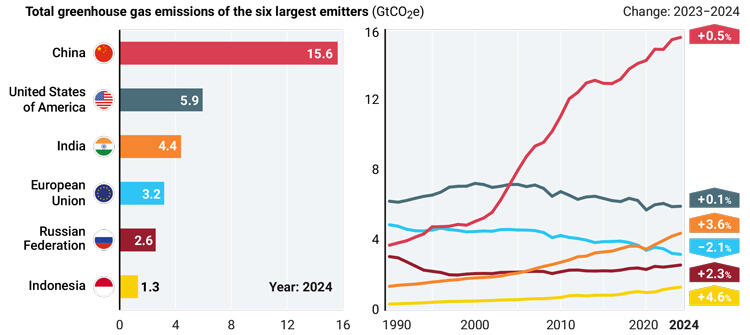
The highest emitter in 2024 was China with 15.6 billion tons, followed by the United States with 5.9 billion tons, India with 4.4 billion tons, the European Union (EU) with 3.2 billion tons, and Russia with 2.6 billion tons. The Group of Twenty (G20) countries and regions, excluding the African Union (AU), accounted for 77% of total emissions, but only 7 countries have set new emissions reduction targets for 2035. The report noted that "action and leadership from G20 nations holds the key."
Provided by UNEP
The Paris Agreement aims to "hold the increase in the global average temperature to well below 2℃ above pre-industrial levels" and pursue efforts "to limit the temperature increase to 1.5℃ above pre-industrial levels." According to the report, achieving this "1.5-degree target" requires reducing emissions by 40% by 2030 and 55% by 2035, compared with 2019 levels. However, even if countries implement measures to achieve their NDCs, emissions in 2035 are projected to decrease by only about 15% compared with 2019 levels, with a high likelihood of exceeding the "1.5-degree target" within the next decade.
In response to these projections, only 60 countries have submitted new NDCs for 2035, less than one-third of the Parties to the Paris Agreement. This suggests that there is insufficient momentum to actively halt global warming, which is believed to have a significant impact on climate change.
UNEP Executive Director Andersen emphasized, "While national climate plans have delivered some progress, it is nowhere near fast enough, which is why we still need unprecedented emissions cuts in an increasingly tight window." UN Secretary-General António Guterres also issued a statement (in the report) saying, "Scientists tell us that a temporary overshoot above 1.5 degrees is now inevitable—starting, at the latest, in the early 2030s. But 1.5 degrees by the end of the century remains our North Star. And the science is clear: this goal is still within reach. But only if we meaningfully increase our ambition."

Provided by UNEP
Japan has set targets to reduce emissions by 46% by FY2030 and 60% by FY2035, compared with FY2013 levels. UNEP predicts in the report that "Japan's current policies will bring it close to its targets, but will fall slightly short." According to the Ministry of the Environment, Japan's emissions for 2024 have not been published, but emissions for FY2023 were 1.1 billion tons.
The UNEP report was released ahead of the leaders' summit held on 6 and 7 November in Belém, Brazil. In connection with the 30th Conference of the Parties to the United Nations Framework Convention on Climate Change (COP30), it calls on countries to take proactive reduction measures. COP30, which began on 10 November, was attended by approximately 140 countries and regions, and is scheduled to hold discussions until 21 November on topics including new NDCs for 2035, funding for developing countries, and forest protection for CO2 absorption.

Provided by UNEP

Provided by the United Nations Framework Convention on Climate Change (UNFCCC)
Original article was provided by the Science Portal and has been translated by Science Japan.